
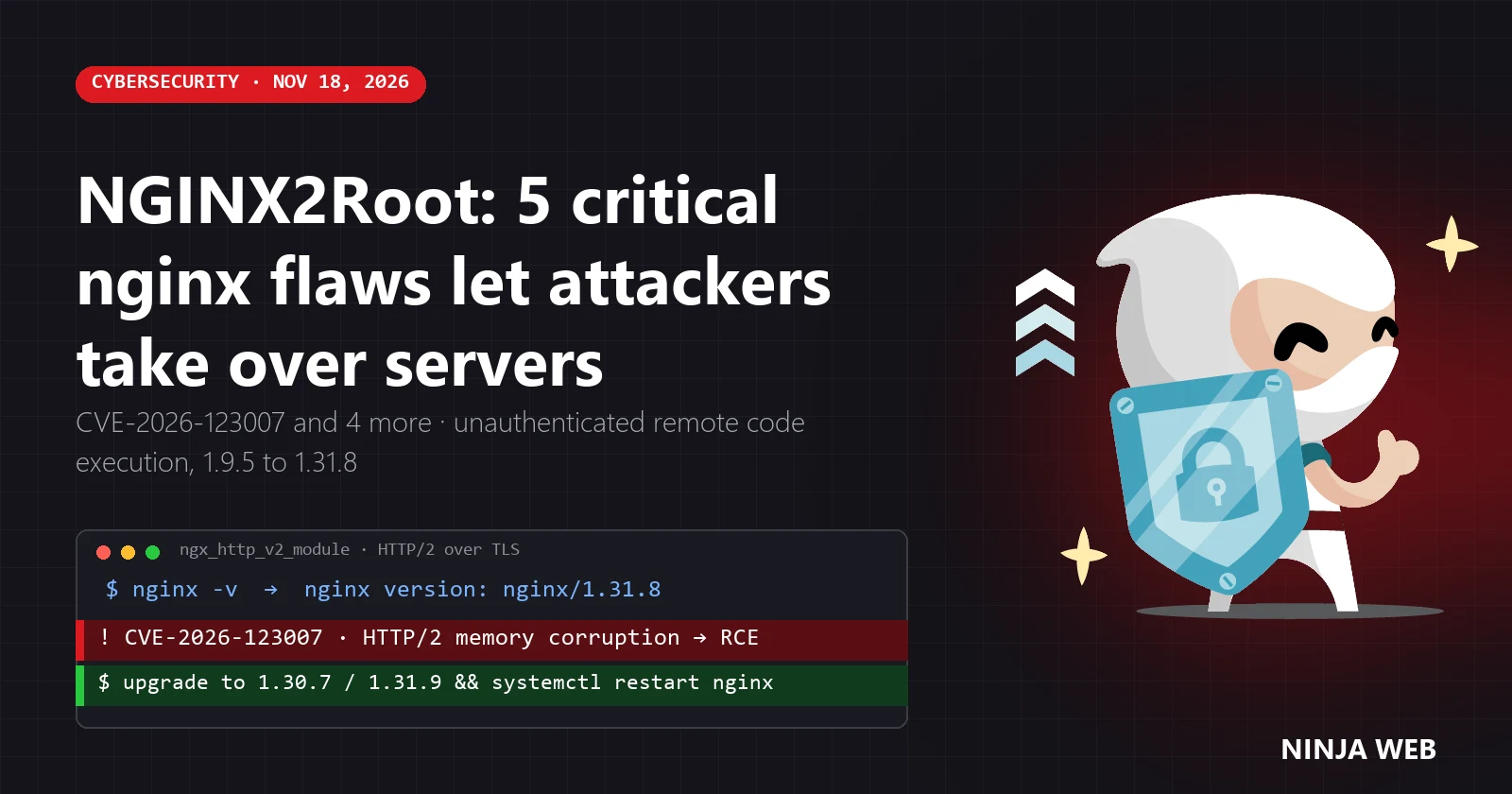
On November 18, 2026, F5 shipped an emergency patch for nginx, the web server and reverse proxy that handles a huge share of the internet's websites. It fixes five critical vulnerabilities that security firm Xint dubbed NGINX2Root: each one lets an attacker run code remotely without logging in, and the most serious (CVE-2026-123007) had been hiding in nginx's HTTP/2 code for more than 10 years.
If your website, online store or APIs sit behind nginx (directly, in a Docker container, on a load balancer or in a Kubernetes Ingress), today is the day to check. Here's what happened, how to tell if you're exposed, and what to do even if you can't update right away.
What is NGINX2Root?
It's the name Xint (part of the Theori group) gave to a set of six flaws: five in nginx and one in the Linux kernel. It works in two steps:
- Get in: the attacker sends crafted traffic to nginx and abuses one of the five memory bugs to run commands with the privileges of an nginx worker process. No username or password needed.
- Escalate to root: they then use a still unpatched flaw in the Linux kernel's SCTP subsystem to become the server's administrator. In its tests, Xint even escaped a Docker container running nginx.
F5 rates all five nginx flaws 9.2 (critical) under CVSS 4.0. The same release fixed five lower-severity issues, including an infinite loop over TLS 1.3 (CVE-2026-118899, 8.7) that can take the service down.
The 5 critical vulnerabilities
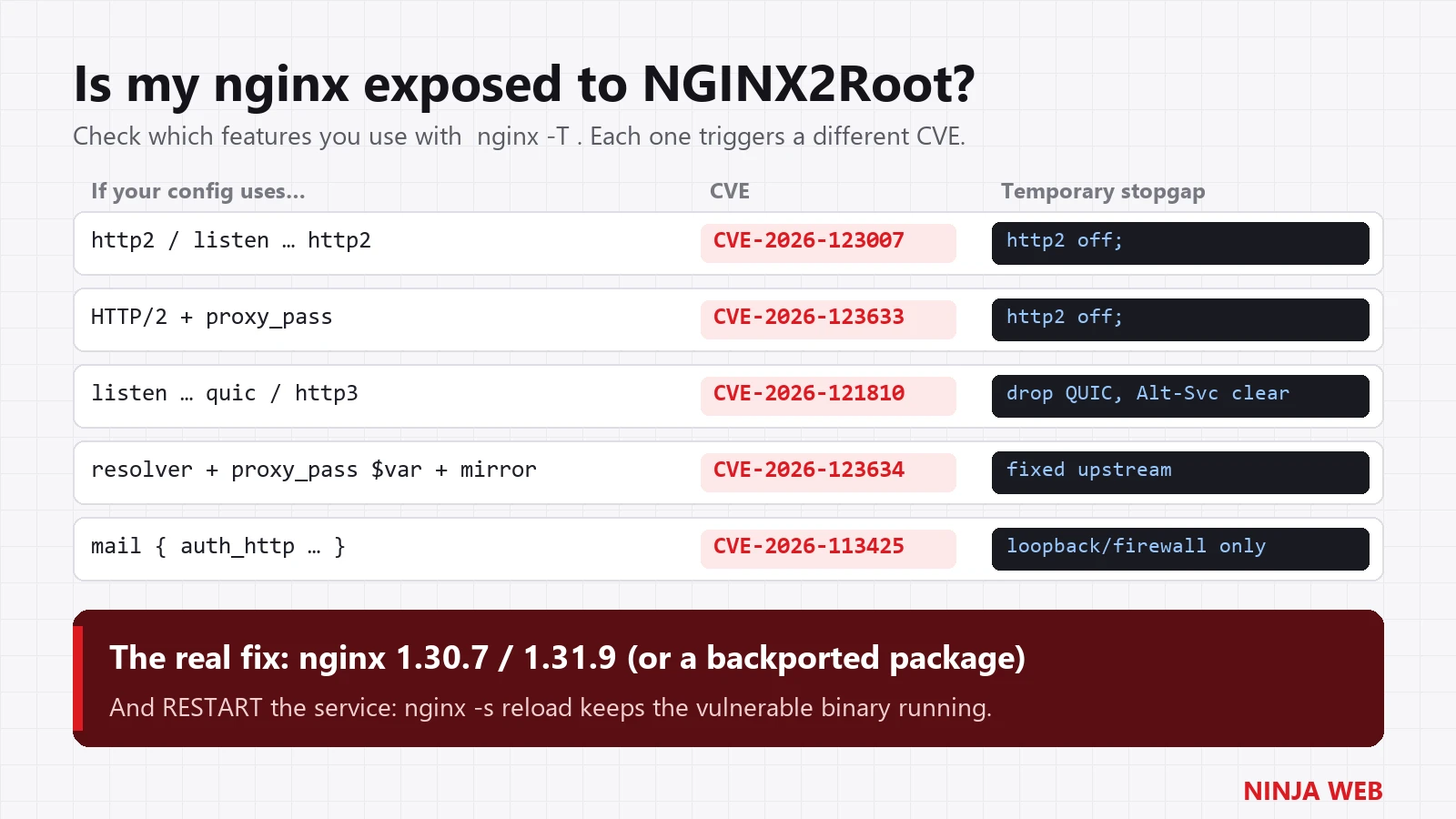
Not all of them affect everyone: each depends on which nginx features you have turned on.
| CVE | Where the bug is | You're affected if… | Present since |
|---|---|---|---|
| CVE-2026-123007 | HTTP/2 (flow control) | HTTP/2 is enabled | 1.9.5 (2015) |
| CVE-2026-123633 | HTTP/2 (use-after-free) | HTTP/2 + nginx as a reverse proxy (proxy_pass) | 1.19.7 |
| CVE-2026-121810 | HTTP/3 / QUIC | you have quic listeners proxying to a backend | 1.25.0 |
| CVE-2026-123634 | DNS resolver | you use resolver, proxy_pass with variables and mirror or SSI | 0.6.18 |
| CVE-2026-113425 | Mail proxy | you use the mail module with auth_http | 0.5.33 |
The most dangerous is CVE-2026-123007, because HTTP/2 is enabled on most HTTPS sites. It affects every nginx open source release from 1.9.5 through 1.31.8.
Is it being exploited?
As of November 18 there are no reports of real-world attacks, and none of the flaws are in CISA's Known Exploited Vulnerabilities (KEV) catalog. But the clock is ticking:
- Rapid7 published a full proof of concept for CVE-2026-123007 on GitHub that achieves remote code execution against nginx 1.31.8 in Docker. It needs demanding conditions (an x86-64 CPU, a lot of HTTP/2 traffic and a fast connection), but it's public.
- Wiz and Xint confirmed they have working exploits, though they haven't released them.
- Xint says it found four of the five flaws with an automated AI-driven scan. Just like Java4Shell last week, the window between “flaw disclosed” and “flaw exploited” keeps shrinking.
How do I know if my server is affected?
- Check your version and the features you use:
If the version is older than 1.30.7 (stable) or 1.31.9 (mainline) and any of those keywords show up, you're exposed.nginx -v nginx -T 2>/dev/null | grep -nE 'http2|quic|http3|resolver|mirror|auth_http' - Watch out for Linux packages: Debian, Ubuntu, Red Hat and other distributions ship the fix without changing the version number that
nginx -vprints. Compare the full package version (dpkg -l nginxorrpm -q nginx) with your distribution's security advisory. As of November 18, Alpine had the fix; Debian, Ubuntu and OpenResty did not yet. - Don't forget containers: check every image that bundles nginx (websites, proxies, Kubernetes Ingress, vendor dashboards) with
docker exec <container> nginx -v. Updating the host doesn't update the nginx living inside an image.
Fixed versions
| Product | Fixed version |
|---|---|
| nginx open source, stable branch | 1.30.7 |
| nginx open source, mainline branch | 1.31.9 |
| NGINX Plus | 37.0.8.1 (LTS) and 37.3.0.1 |
| nginx 1.29 or older / NGINX Plus R33–R36 | No patch: move to a supported version |
Version 1.31.9 also rejects some malformed requests it used to accept, which could affect older clients. If you want the most conservative change, go with the 1.30.7 stable branch.
What to do today: a 5-step plan
- Inventory every nginx: servers, containers, load balancers, Kubernetes Ingress and vendor appliances. Start with anything internet-facing.
- Upgrade to 1.30.7 or 1.31.9 (or your distribution's fixed package). In Docker, rebuild on the new base image and recreate the container.
- Restart, don't just reload.
nginx -s reloadapplies the new configuration, but the vulnerable binary keeps running and open HTTP/2 connections stay on the old workers. Usesystemctl restart nginxor recreate the container. - If you can't upgrade today, turn off what you don't need:
Disabling HTTP/2 blocks the two HTTP/2 flaws (visitors fall back to HTTP/1.1 and the site keeps working, but gRPC services break). It does not protect against the other three: for those, removeserver { listen 443 ssl; http2 off; # nginx 1.25.1 or later ... }quiclisteners and sendAlt-Svc: clear, replace variable-basedproxy_passwith a fixedupstream, and restrict the mail proxy to loopback or trusted IPs. To confirm from outside that HTTP/2 is off:
If it printsopenssl s_client -connect yourdomain.com:443 -servername yourdomain.com -alpn h2 &1 | grep ALPNNo ALPN negotiated, HTTP/2 is disabled on that port. - Close the door to root. The kernel SCTP flaw has no patch yet. If your servers don't use SCTP (almost no website does), block the module:
This prevents it from loading but doesn't unload it if it's already active; in that case, reboot the server.echo 'install sctp /bin/false' | sudo tee /etc/modprobe.d/disable-sctp.conf
To spot attack attempts, Xint recommends watching for nginx worker processes that exit abnormally or execute commands (execve), and HTTP/2 connections with unusual traffic volumes. The attack may leave very little trace in the access log.
What if my site is on shared hosting or in the cloud?
If you use managed hosting, a platform like Cloudflare or your cloud provider's load balancer, the internet-facing nginx may not be yours. Your server may still run its own nginx behind it, though. Ask your provider or IT team: “Do we run nginx anywhere, and is it updated to 1.30.7, 1.31.9 or the fixed package?” If they manage servers for you, ask for confirmation in writing.
Frequently asked questions
Which nginx versions are affected by CVE-2026-123007?
Every nginx open source release from 1.9.5 through 1.31.8 with HTTP/2 enabled. It's fixed in 1.30.7 and 1.31.9.
Is disabling HTTP/2 enough?
No. Disabling HTTP/2 stops two of the five critical flaws, but not the HTTP/3, DNS resolver or mail proxy ones. It's a stopgap; the fix is to upgrade.
Does it affect Apache, IIS or LiteSpeed?
No. NGINX2Root is specific to nginx and products built on it, such as NGINX Plus, OpenResty and many Kubernetes Ingress controllers. The Linux kernel flaw does affect any Linux server, but on its own it requires the attacker to already be inside.
Why is it called NGINX2Root?
Because the full chain goes from nginx to “root”, the user with full control of the server. F5 and nginx.org don't use the name: they track each flaw by its CVE number.
Need help checking your servers?
At NINJA WEB we manage servers and containers running nginx, apply patches without stopping your operations and review security configurations. Learn about our cybersecurity services or contact us and we'll check together whether you're exposed to NGINX2Root.
Sources: Xint, Tenable, Qualys, Atlas, Cycode, The Hacker News. Also read: Java4Shell (CVE-2026-114938): The Critical Java Flaw and How to Protect Yourself.