
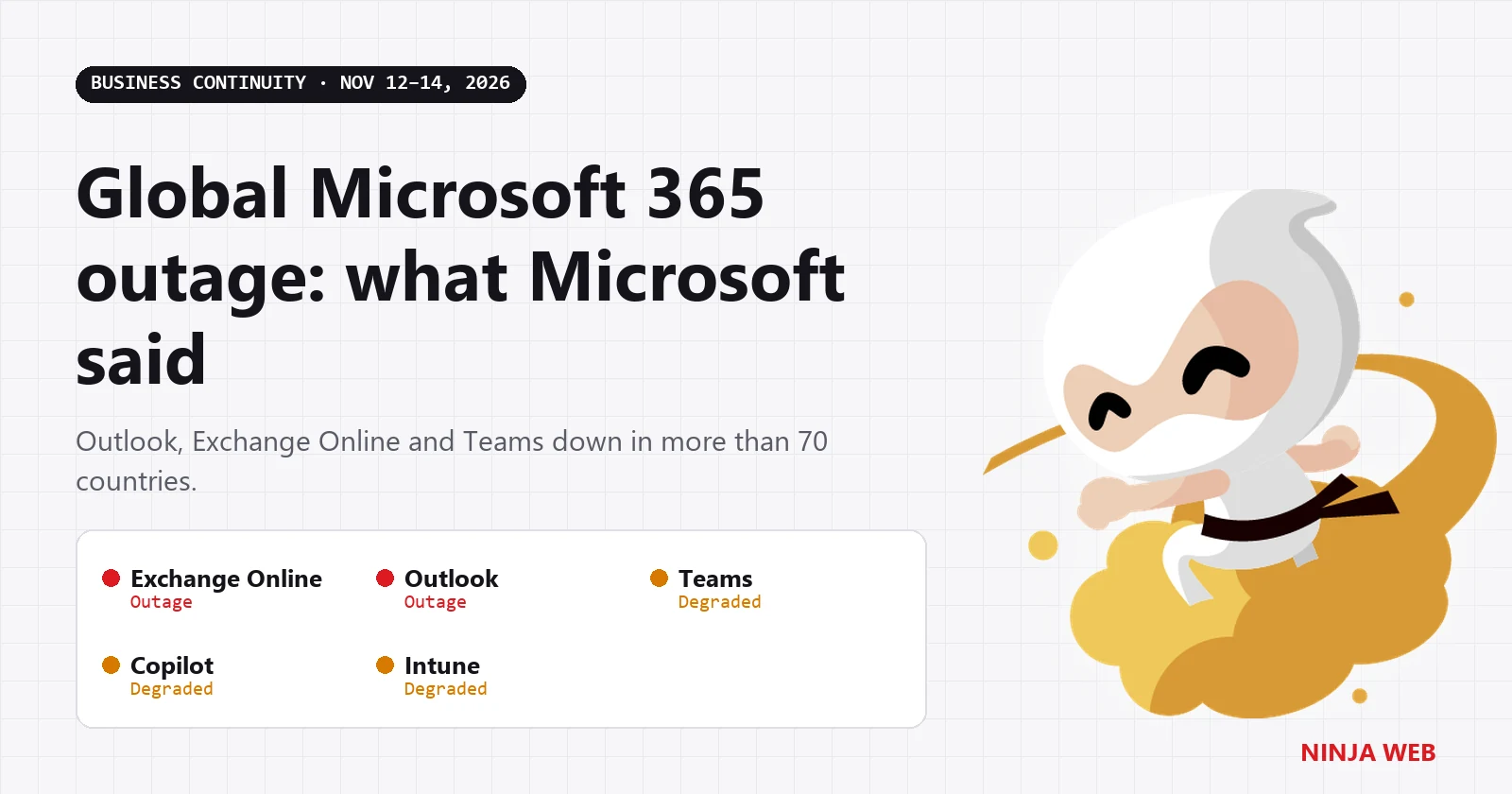
Between November 12 and 14, 2026, the Microsoft 365 outage left businesses, governments, hospitals and schools in more than 70 countries without email. Outlook and Exchange Online were hit hardest; Teams, Copilot and Intune also had problems. For almost two days, millions of people couldn't send or receive a single work email.
Microsoft has now explained what went wrong. Here is a summary of its statement, the real-world impact and, above all, what your business can do so the next provider outage doesn't stop your operations.
What did Microsoft say about the outage?
Microsoft was clear on one point: it was not a cyberattack, nor was it caused by AI agents. The company attributed it to settings applied to servers after an update: the process that establishes secure connections became overwhelmed and servers stopped handling requests. Microsoft apologized, saying it was "deeply sorry."
A later technical summary shared by Microsoft executive Charles Lamanna added detail:
- A previously undetected defect made networking gateway servers unresponsive under certain load conditions. At peak, over 80% of those servers were unresponsive.
- A change in traffic allocation increased load, and maintenance had reduced capacity by 14%.
- Automated rollbacks didn't help: the change behind the problem had been deployed in July 2026, months earlier.
- Exchange Online couldn't be moved to a secondary gateway group, unlike other products. That's why email was hit hardest.
- When the fix was deployed, returning traffic overwhelmed the recovering servers, and automated routing had to be disabled so they could recover.
Microsoft 365 admins can follow the official report under reference MO1550821 in the admin center.
The impact: more than a day without email
- Problems reported in more than 70 countries; Microsoft 365 has about 430 million users.
- Anderson Economic Group estimated roughly $7 billion in lost productivity.
- Toronto hospitals and the UK's NHS went back to paper, and some operations were cancelled.
- Brazil's Supreme Federal Court suspended procedural deadlines for November 12 and 13.
- Traders reverted to phone and fax.
Days later, Workday also suffered an outage that left thousands of companies unable to access payroll. The lesson repeats itself: relying on a single provider is a business risk, not just a technical one.
Is there a global blackout on November 17? No
After the outage, a supposed "global blackout" scheduled for November 17 spread on social media. It's false: neither Microsoft nor any other company has announced a planned shutdown. Fact-checkers such as France 24 have debunked it. What is real is the retirement of Microsoft 365's People, Files and Calendar companion apps, which stop working on December 16.
5 lessons for your business
1. Have a continuity plan for email
Decide how your team will communicate if email goes down: an alternate channel (WhatsApp Business, Google Chat, Slack), a list of critical contacts outside Outlook, and someone responsible for updating customers. Our business email service includes backup and continuity setup.
2. Don't depend on one provider for everything
If your email, files, calls and identity all live in the same cloud, one failure shuts everything down. Separating critical services or having alternatives reduces the impact.
3. Your website must stay up
During the outage, many companies went silent in front of their customers. A website on well-managed, independent hosting, with a contact form and WhatsApp, keeps working even when corporate email fails.
4. Monitor, don't guess
Subscribe to your providers' service status and set up alerts. Knowing within minutes that the problem is on the provider's side (not your network) saves hours of pointless troubleshooting.
5. Proactive maintenance and support
At NINJA WEB we keep our clients' websites and services optimized, updated, monitored and behind a firewall, with verified backups. When a giant like Microsoft fails, a solid maintenance and support plan makes the difference between a scare and a lost day.
Frequently asked questions
Was the Microsoft 365 outage a cyberattack?
No. Microsoft confirmed the cause was a defect in its networking gateway servers, made worse by a configuration change, and ruled out an attack.
How long did the Microsoft 365 outage last?
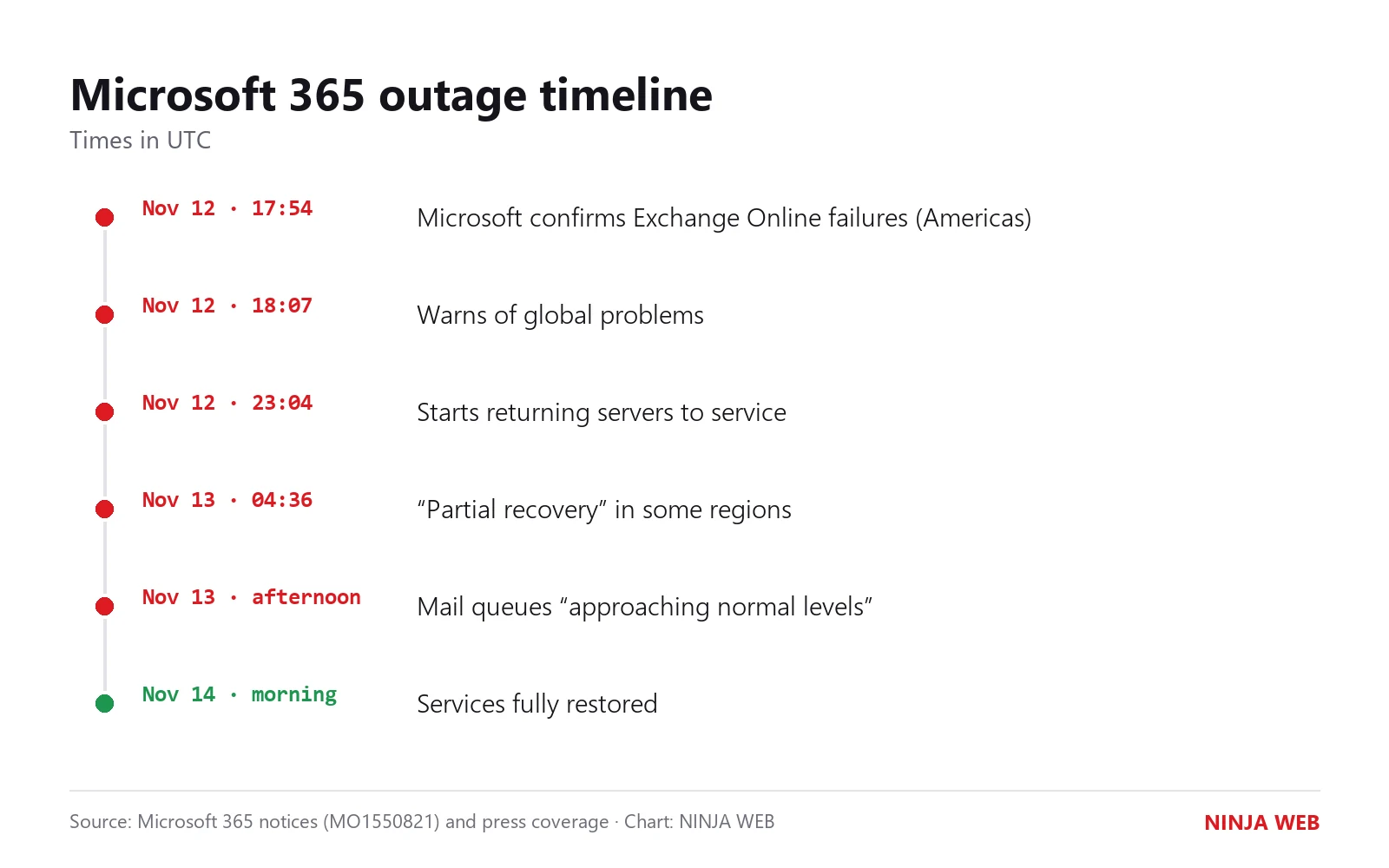
It began on the afternoon of November 12, 2026 (UTC) and services were fully restored on the morning of November 14: about a day and a half.
Were emails lost during the outage?
Microsoft worked through the accumulated mail queues during recovery, so most messages arrived late. If an important email is missing, ask the sender to resend it.
Is your business ready for the next outage?
We help you design a continuity plan for your email, website and systems. Contact us and we'll review your single points of failure together.
Sources: Wikipedia, University of Illinois Technology Services, Fox Business, Engadget. Also read: Optimizely malware: what happened and how to protect your site.