
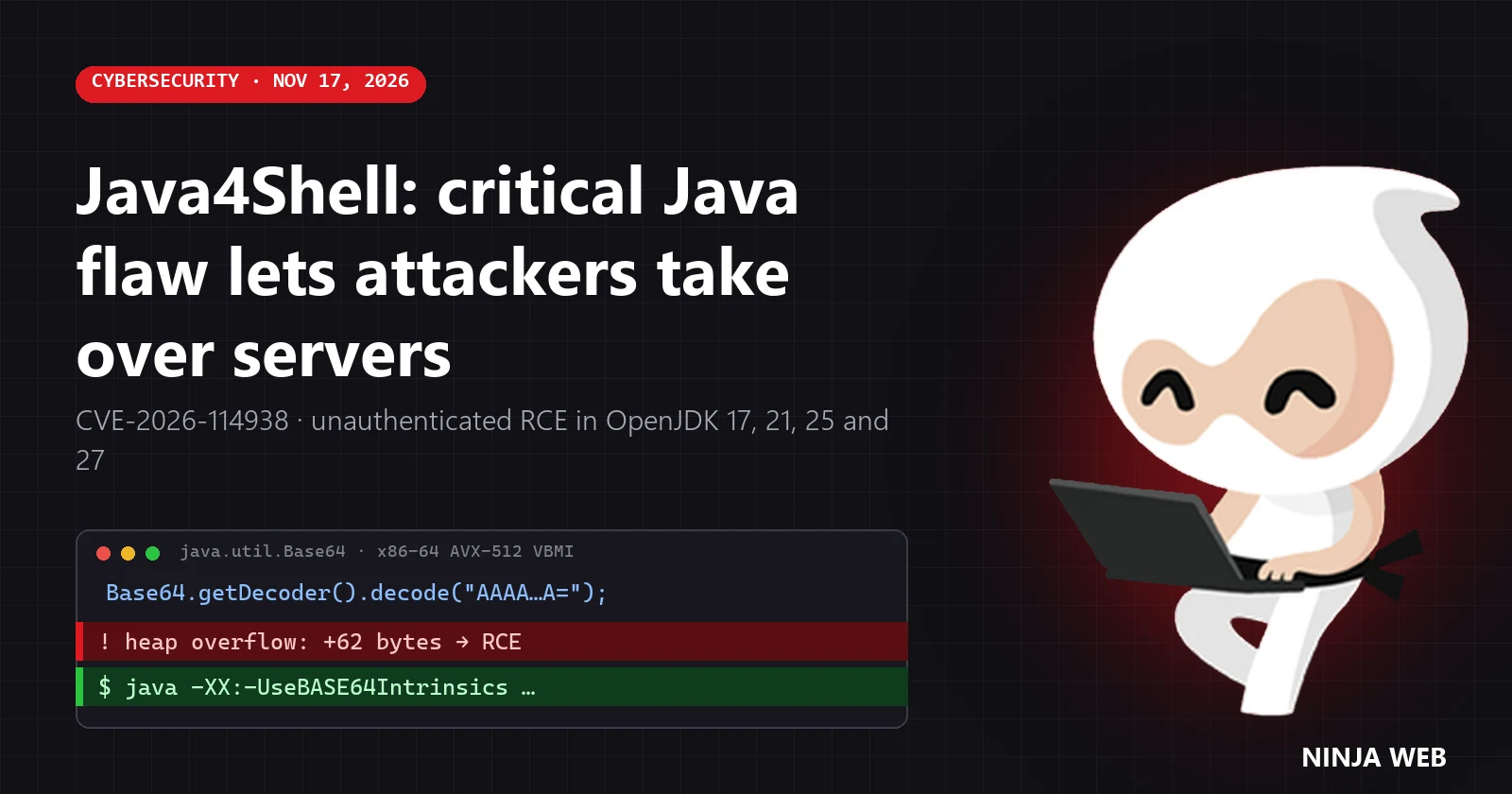
On November 17, 2026, Java4Shell (CVE-2026-114938) was disclosed: a flaw in the Java virtual machine that lets an attacker run code remotely without logging in on servers running widely used applications such as Jenkins, Jira, Confluence and Keycloak. The same day, the US Cybersecurity and Infrastructure Security Agency (CISA) issued an alert urging organizations to patch immediately.
The name is a nod to Log4Shell, the 2021 Log4j flaw that sent half the world scrambling to update. Java4Shell isn't quite as universal, but the message is the same: if your business runs Java software, today is the day to check. Here's what it is, how to tell if you're affected in 3 steps, and what to do even if you can't update yet.
What is Java4Shell (CVE-2026-114938)?
It's a memory-corruption bug in Java's Base64 decoder (java.util.Base64), the function that turns encoded text back into data. Base64 is everywhere: login tokens, HTTP headers, certificates, attachments, APIs.
To go faster, the HotSpot JVM uses a hand-written assembly version of that decoder that takes advantage of the AVX-512 VBMI instructions in modern processors. According to Qualys, a very short malformed input makes that code write 62 bytes past the end of its buffer before Java rejects the input. Researchers say something as simple as 64 letter “A”s followed by an “=” sign is enough.
With that, an attacker can:
- Execute code on the server (take over the application).
- Read Java memory, which may hold keys, tokens or personal data.
- Crash the application by bringing down the JVM.
It isn't limited to servers either: researchers describe an attack against Java clients that connect over TLS to a malicious server.
Who found it and how serious is it?
It was found by security firm Calif (researcher Quang Luong) while auditing OpenJDK internals with AI assistance: they say they found the bug in about an hour and had a first working exploit roughly two hours later, for under $200 in AI costs. It's a reminder that attackers use AI too, and the window between “flaw disclosed” and “flaw exploited” keeps shrinking.
There are two severity scores: Calif rates it 9.2 (critical) under CVSS 4.0, and Oracle 8.1 (high) under CVSS 3.1. In practice, treat it as critical on any internet-facing system.
As of November 17, there is no public confirmation of active exploitation. However, the trigger, root cause and technique are already public, and a proof of concept for the memory corruption exists. Calif is withholding product-specific exploits to give organizations time to patch.
Which applications are at risk?
Researchers achieved remote code execution against default configurations of:
- Without authentication: Keycloak, Atlassian Jira, Atlassian Confluence, JFrog Artifactory, Jenkins and PingFederate.
- With an authenticated user: Apache Kafka, Apache Solr, Elasticsearch, Gerrit and Spinnaker.
- They also exploited sample applications built with Spring Boot and Apache Struts, so custom Java software can be exposed as well.
The list isn't exhaustive. Many products ship their own bundled Java (in the installer or the Docker image), and that Java isn't updated by operating system patches.
How do I know if my server is vulnerable?
All three conditions must be true:
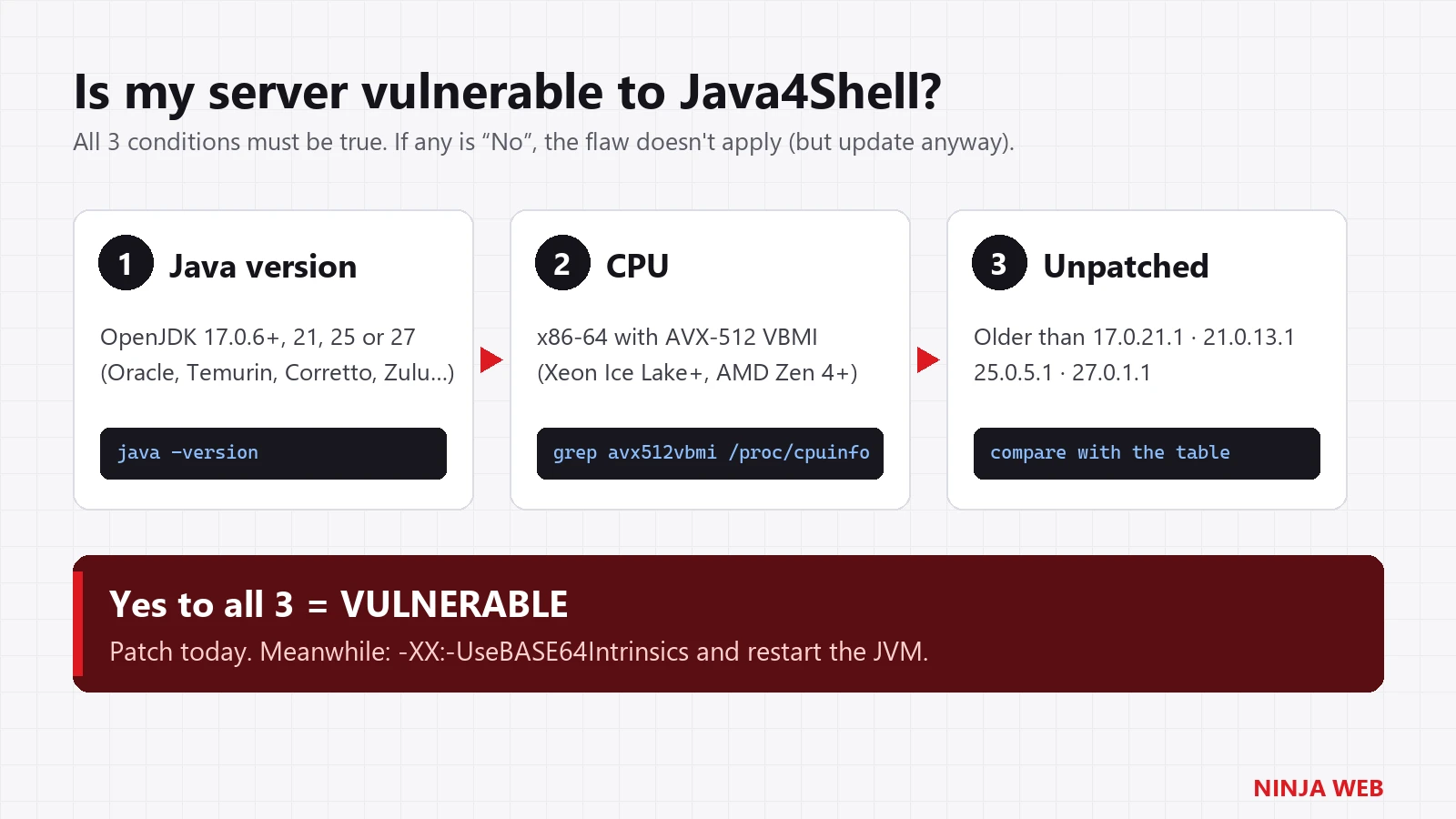
- Java version: OpenJDK 17.0.6 or later, Java 21, 25 or 27. This covers every OpenJDK-based distribution: Oracle Java SE, Eclipse Temurin, Amazon Corretto, Microsoft Build of OpenJDK, Azul Zulu, BellSoft Liberica, Red Hat OpenJDK, SapMachine and GraalVM. Check with
java -version. - CPU: x86-64 with AVX-512 VBMI support, such as Intel Xeon Ice Lake, Sapphire Rapids, Emerald Rapids or Granite Rapids, and AMD EPYC or Ryzen Zen 4 and newer. ARM64 servers (like AWS Graviton) are not affected. On Linux, if this command prints all four flags, the CPU qualifies:
grep -m1 '^flags' /proc/cpuinfo | tr ' ' '\n' | grep -E '^(avx512f|avx512bw|avx512vbmi|bmi2)$' - Unpatched: your version is older than the fixed one (see table).
Note: just because your server lacks AVX-512 VBMI today doesn't mean you're safe for good. In the cloud, a virtual machine can land on newer hardware after a restart. Use the CPU check to prioritize, not to skip the patch.
Fixed versions
Oracle shipped the fixes on November 17 in its November 2026 Critical Security Patch Update:
| Java line | Affected versions | Fixed version |
|---|---|---|
| Java 17 | 17.0.6 and later | 17.0.21.1 |
| Java 21 | all builds before the patch | 21.0.13.1 |
| Java 25 | all builds before the patch | 25.0.5.1 |
| Java 27 | all builds before the patch | 27.0.1.1 |
| Java 8 Enterprise Performance Pack | 8u511b33-perf | 8u513-perf |
| Standard Java 8 and 11 | Not affected | — |
Amazon Corretto 17.0.21.1.2 already includes the fix. Other distributions (Temurin, Zulu, Microsoft, Red Hat, etc.) publish on their own schedules: check your vendor's advisory.
What to do today: a 5-step plan
- Inventory every Java runtime. Not just the one installed on the server: also the ones bundled inside applications, Docker images and appliances. CISA warns many of them don't show up in software inventories.
- Prioritize internet-facing systems. Start with Jenkins, Jira, Confluence, Keycloak, Artifactory, portals and public APIs.
- Update Java to your distribution's fixed version and restart services. If you use containers, rebuild images on the new base image.
- If you can't update today, apply the temporary mitigation and restart the JVM:
It disables the accelerated decoder where the bug lives, so Java falls back to its standard decoder. Performance may drop if your application handles a lot of Base64, so test it first. The alternative-XX:-UseBASE64Intrinsics-XX:UseAVX=2also works, but only on Intel and AMD: on ARM the JVM won't start with it. Neither replaces the patch. - Watch for signs of attack: unexpected JVM crashes or restarts, Java processes spawning a shell or opening new outbound connections, and Java runtimes that weren't in your inventory.
One important detail: according to Qualys, a reverse proxy or web application firewall is not a general mitigation here, and input size limits aren't enough either, because the malicious input is very short. The real defense is updating.
What if my company doesn't write Java?
You may still be running it without knowing. Java powers many accounting systems, ERPs, developer tools, authentication servers, internal search engines and vendor dashboards. Ask your IT team or software vendors: “Does this system run Java 17 or later, and have you applied the November patch?” If they manage servers for you, ask for confirmation in writing.
Frequently asked questions
Does Java4Shell affect Java 8 or 11?
Standard Java 8 and 11 releases are not affected, because the vulnerable code arrived in OpenJDK 17.0.6. The exception is Oracle Java SE 8 Enterprise Performance Pack (8u511b33-perf), fixed in 8u513-perf.
Does it affect my personal computer?
The main risk is on servers, but a vulnerable Java client connecting to a malicious server can also be attacked. If you have Java 17 or later installed on your computer, update it.
Is Java4Shell being exploited?
As of November 17, 2026, there's no public confirmation of real-world attacks, but the technical details are already circulating, so don't wait.
Is it the same as Log4Shell?
No. Log4Shell (2021) was a flaw in the Log4j library; Java4Shell is in the Java virtual machine itself and only on CPUs with AVX-512 VBMI. They're similar in impact: unauthenticated remote code execution in very widely used software.
Need help checking your servers?
At NINJA WEB we inventory dependencies and containers, scan for vulnerabilities and apply patches without stopping your operations. Learn about our cybersecurity services or contact us and we'll check together whether you're exposed to Java4Shell.
Sources: CISA, Oracle Critical Security Patch Update (November 2026), Qualys, BleepingComputer, Rapid7. Also read: Optimizely malware: what happened and how to protect your website.