
On November 16, 2026, one of the year's largest web supply chain attacks was confirmed: Optimizely malware was served for hours through the A/B testing platform used by thousands of brands, reaching visitors of 178 organizations including Zoom, the BBC, CNN, HSBC, IKEA, GitLab and Ledger. The code stole cryptocurrency, card data and cookies, and even tried to compromise iPhones.
The unsettling part: none of those websites was hacked directly. Compromising one third-party script that they all trusted was enough. Here is what happened, why it matters to small and mid-sized businesses too, and the concrete measures that keep an attack like this off your website.
What happened with Optimizely?
Optimizely Web runs on a JavaScript snippet that each customer adds to their site, served from cdn.optimizely.com. That file includes a field called Project JavaScript, custom code that runs on every page.
According to research published by Report URI, an attacker managed to write malicious code into that field for hundreds of projects belonging to different customers. The CDN was not poisoned: it simply delivered what it had stored. Some outlets report that Optimizely attributed the access to a flaw in its account signup flow; at the time of writing, official details are still limited.
Attack timeline (November 16, UTC)
- 04:21 – first injection observed (BBC).
- 08:10 – first build of
track.js, which swaps crypto wallet addresses. - 13:43 – the attacker adds a card skimmer.
- 17:13 – iPhone exploits injected for iOS 18.6 or earlier.
- 19:24 – a sweep finds 186 of 1,611 snippets infected.
- 21:52 – after mass clean-up, only 1 snippet remains infected.
The malicious payload was rebuilt 26 times in a single day. The attacker was tuning the weapon in real time while millions of people browsed those sites.
What the malware did
- Swapped cryptocurrency addresses (Bitcoin, Ethereum, TRON, Solana and more) in page text, forms, links and the clipboard. Anyone who copied an address ended up sending funds to the attacker.
- Skimmed credit cards: number, expiry and CVV from the site's own payment forms. Payments in hosted iframes (Stripe, Adyen) were out of reach.
- Stole cookies and screenshots of what the visitor saw, including session cookies without the
HttpOnlyflag. - Targeted iPhones and iPads with exploit kits hidden in an iframe. A visible symptom: the page reloaded every 60 seconds.
Why this matters to your business too
You may not use Optimizely, but your website almost certainly loads third-party scripts: live chat, ad pixels, heatmaps, review widgets, analytics, social buttons. Every one of those scripts has the same power as your own code: it can read forms, change text and send data to any server.
This is a web supply chain attack, exactly the kind of risk that PCI DSS 4.0 (requirements 6.4.3 and 11.6.1) requires you to control on any payment page: a script inventory, a justification for each script, and detection of unauthorized changes.
The defense that worked: Content Security Policy
Report URI checked the Content Security Policy (CSP) of the affected hosts. The result is a direct lesson:
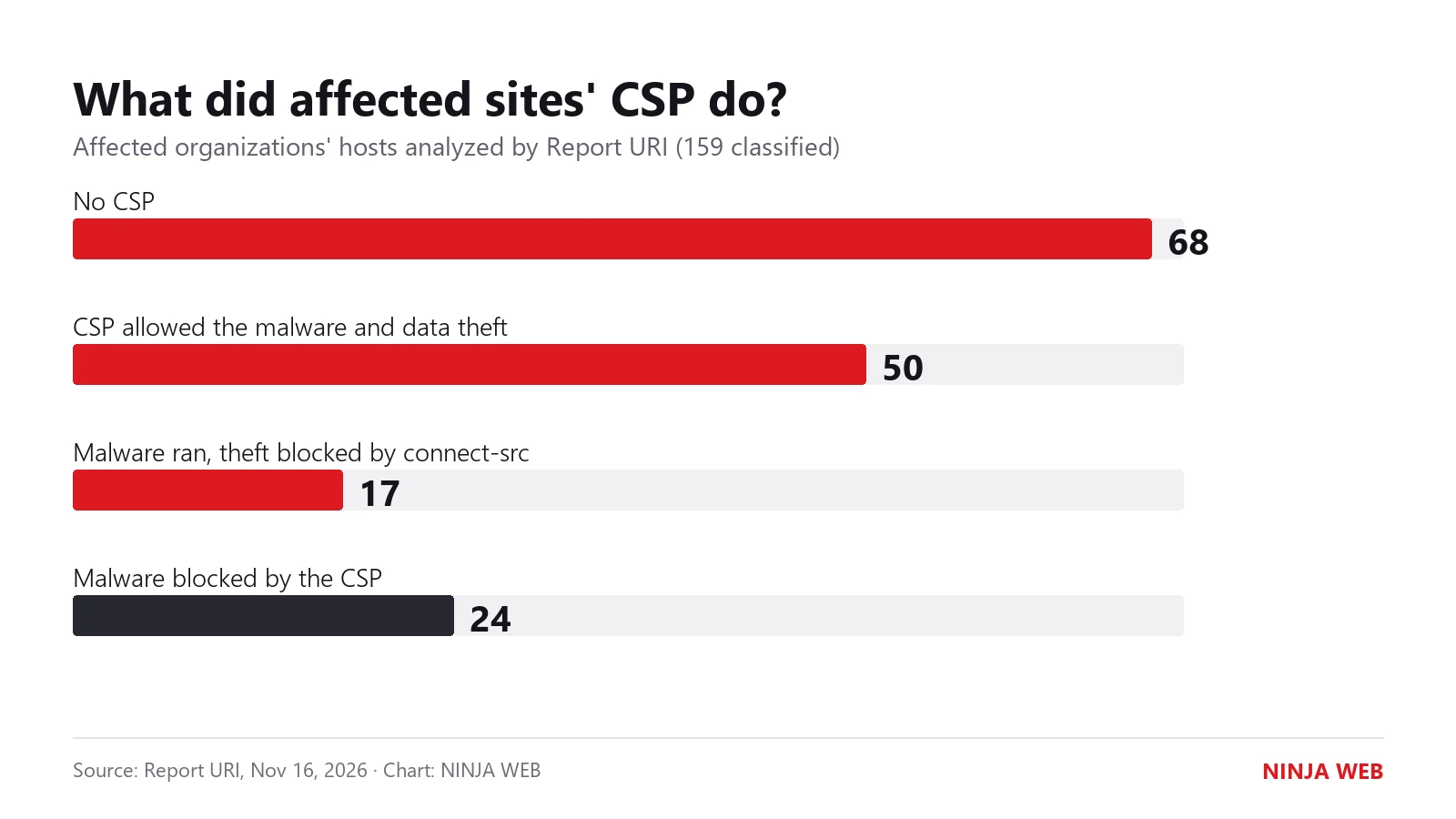
| Outcome | Hosts |
|---|---|
| No CSP | 68 |
| CSP allowed the malware and data theft | 50 |
Malware ran, theft blocked by connect-src | 17 |
| Malware blocked by the CSP | 24 |
Sites with a strict CSP blocked the attack even though the Optimizely script was compromised. Those that failed mostly had two weak settings: 'unsafe-eval' (which Optimizely's own documentation tells customers to allow) and 'strict-dynamic', which trusts anything the script loads afterwards.
How NINJA WEB protects the websites we manage
At NINJA WEB we don't wait for the headline. The websites we build and manage are kept up to date, optimized and protected in layers:
- Web application firewall (WAF) and server-side rules that filter malicious traffic before it reaches your site.
- Security headers and CSP with an allowlist of domains in
script-srcandconnect-src, so a compromised script can't send data to unknown servers. - Third-party script inventory: we only load what the business actually needs, and we review every new integration.
- Payments in the gateway's hosted iframes, never in-house card forms unless they are truly required.
- Session cookies with
HttpOnly,SecureandSameSite, so injected scripts can't read them. - Continuous updates and dependency scanning, with maintenance and support plans that include monitoring and backups.
On top of that, an optimized website is a safer website: fewer scripts mean a smaller attack surface and faster load times, which also helps your Google rankings.
What to do today if your site uses Optimizely or other third-party scripts
- Check Project JavaScript and experiment code for
1688360.cc,atob(or any code you don't recognize. - Audit users, API tokens and integrations with write access, and rotate every credential.
- If your site has its own card fields, treat cards entered on November 16 as potentially exposed and consider notifying customers.
- Invalidate sessions and secrets stored in cookies without
HttpOnly. - Deploy a CSP with a restricted
connect-src, no'unsafe-eval'and reporting enabled (start inReport-Onlymode if you're worried about breaking something). - Inventory every external script and remove the ones that no longer add value.
If you run WordPress, pair this with our guide on how to improve WordPress website security.
Frequently asked questions
Was my site affected if I don't use Optimizely?
Not by this specific incident. However, the same actor previously used other third-party scripts (Kissmetrics, StorifyMe and Minute Media) to inject code, so it's worth reviewing every external script you load.
I visited one of the affected sites. What should I do?
Update your iPhone or iPad (iOS 18.7.3 or 26.3 and later), watch your card statements and, if you sent cryptocurrency, verify that the destination address was the right one.
What is a Content Security Policy (CSP)?
It's an HTTP header that tells the browser which domains it may load scripts from and which servers it may send data to. Configured properly, it turns a compromised script into a failed attempt.
Want to know how exposed your website is?
Our cybersecurity team reviews your third-party scripts, headers, CSP and firewall configuration, and hands you a prioritized plan. Request an assessment and we'll help you close the door before anyone tries to get in.
Sources: Report URI, Cyber Security News, Cyber Kendra. Also read: global Microsoft 365 outage: what Microsoft said.