
AI agents that “do things for you” (pay bills, move money between accounts, review transactions) have run into the banks. In recent weeks, Citi, PNC and Citizens joined JPMorgan Chase and Bank of America with a clear message: if you give your credentials to a third-party AI agent, everything that agent does is on you, even if the agent makes a mistake, leaks or gets hacked.
These are US banks, but the issue affects everyone: many people and businesses in Latin America hold accounts there, use the same AI tools, and the region's banks tend to adopt these practices soon after. Here's what changed and how to use AI agents without carrying the risk.
What each bank said
| Bank | What it did | When |
|---|---|---|
| Citi | Updated its online user agreement: whatever an outside agent does with your credentials counts as authorized by you, even if the agent leaks or is hacked. Its own agents are carved out. | November 2026 |
| PNC | Changed its terms: bank-approved connections only; no handing passwords or one-time codes to outside agents, which generally can't initiate payments. | Nov 18, 2026 |
| Citizens | Emailed customers warning they may be responsible for what their AI assistant does. | Week of Nov 16 |
| Bank of America | “Protecting your finances in the AI world” email: if you share your credentials with an AI tool, you're responsible for the resulting activity. | October 2026 |
| JPMorgan Chase | Announced a similar policy, per TechCrunch. | October 2026 |
The most explicit case is Citi. According to TechCrunch, the bank changed its terms this week, and a spokesperson said they want customers to “understand the risks associated with sharing banking credentials.” Per Decrypt, actions taken with credentials handed to an outside agent are treated as authorized by the customer even if the tool ignores instructions, exceeds its permissions or shares the credentials with someone else. Citi would also have no obligation to investigate whether the agent followed your prompts, “subject to applicable law.” Agents offered by Citi itself are carved out of the clause.
Why are banks doing this?
- To the bank, an agent with your password is you. If the agent logs in with your username and one-time code, the bank can't tell whether it was you or a program. The new terms make clear it won't cover that gap.
- Agents can be tricked. An agent that reads emails, web pages or invoices can pick up hidden instructions (prompt injection) and run a transfer you never asked for. We show this with an interactive example on our AI for business page.
- Every agent is one more place your keys live. If the agent's vendor suffers a breach, your credentials go with it. That's exactly what happened in the Cursor hack: stored conversations containing passwords ended up with an attacker.
What about consumer protection?
In the US, Regulation E caps what a customer loses to unauthorized electronic transfers, and banks can't waive that protection by contract. The open question is whether a transfer made by an agent you yourself gave access to counts as “unauthorized.” No court has settled it yet, and sources disagree on whether regulators have weighed in. Meanwhile, banks have already written their position into their contracts.
How to use AI agents with your money without carrying all the risk
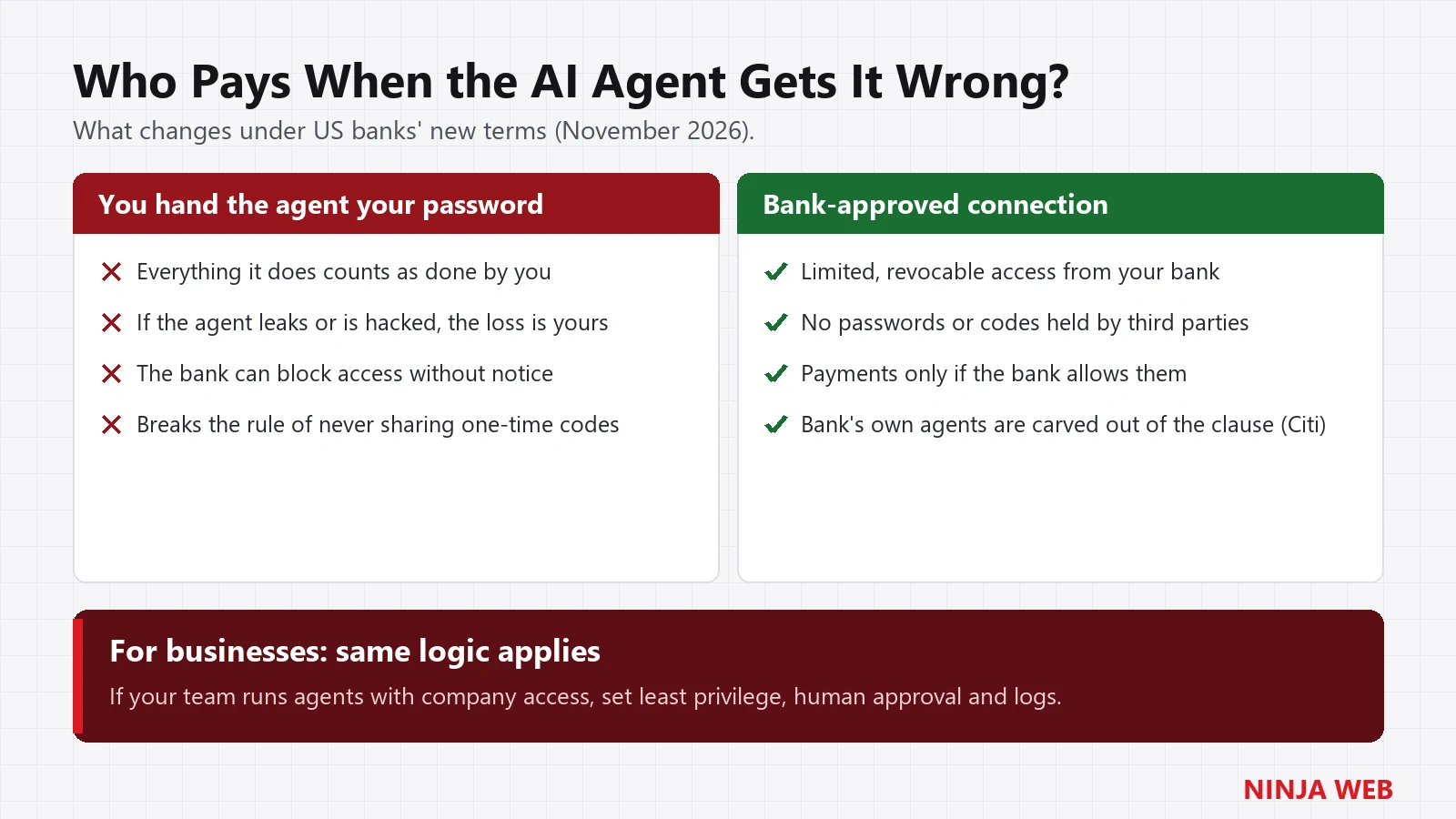
- Never give your username, password or one-time codes to an AI agent or app. No serious bank will ask you to.
- Use your bank's approved connections (official aggregators or open banking): they grant limited, usually read-only access that you can revoke from online banking.
- Prefer read-only. An agent that analyzes your spending doesn't need to move money.
- Set limits: turn on alerts for every transaction, daily transfer limits and manual approval for new payees.
- Check what has access today. Go to the connected apps or third parties section of your online banking and remove what you no longer use.
For businesses: the same rule applies inside your organization
If your team starts using AI agents to pay vendors, reconcile accounts or handle purchasing, think like the bank: whatever the agent does with company credentials, the company did. Before connecting it to anything that moves money:
- Give it least privilege and its own accounts (never a person's credentials).
- Require human approval for payments and changes to banking details.
- Keep logs of every agent action and review them.
- Read your bank's and your AI vendor's terms: who's liable if something goes wrong?
Frequently asked questions
Can I still use AI agents with my bank?
Yes, through the connections your bank approves. What changes is liability if you hand over your username and password directly.
Do the bank's own AI assistants follow the same rule?
No. In Citi's case, AI agents and tools offered by the bank itself are carved out of the clause.
Does this apply outside the US?
For now these are US banks, but it applies if you bank with them. And the advice is universal: no bank happily covers a transaction made with credentials you shared.
Want to use AI in your business without opening new risks?
At NINJA WEB we design and build AI agents for business with least privilege, human approval and audit logs, and our cybersecurity team reviews their security. Contact us and let's look at it together.
Sources: TechCrunch, TechCrunch (Bank of America), Decrypt / Yahoo Finance, Startup Fortune.